

Bringing the World Home: Why Families Should Embrace Language Learning
In today’s connected world, learning a second language is one of the most valuable gifts families can offer children. Beyond academics, it opens...
4 min read

Catholic homeschooling blends academic excellence with spiritual formation, helping families raise faithful, well-rounded children through daily routines rooted in faith.
For Catholic homeschool families, education is more than mastering math facts or reading fluency. Our goal is forming whole, faithful persons. As parents guide their children through essential foundational academics, they also hold the sacred responsibility of nurturing spiritual growth.
Balancing academics and faith formation in Catholic homeschooling doesn't require a seminary degree or hours of added work. With thoughtful planning and a few creative routines, your family's daily routine can reflect the truth that faith and learning absolutely go hand in hand.
This article offers practical ways to integrate faith into everyday academics, ideas for aligning your homeschool with the liturgical year and sacraments, simple, age-appropriate practices for prayer, saints, and holy days and encouragement to keep your homeschool Christ-centered without feeling overwhelmed.
The Catholic Church reminds us that parents are the first and primary educators of their children. As the Catechism of the Catholic Church teaches:
“Parents have the mission of teaching their children to pray and to discover their vocation as children of God.” (CCC, 2226)
That mission becomes the heartbeat of a Catholic homeschool. But how do we ensure that academic goals and spiritual formation don’t compete for time and instead complement one another?
Sometimes families feel torn between pursuing academic rigor and fostering a strong spiritual life—but these two goals are not in conflict. In fact, the Catholic tradition holds intellectual formation as a vital part of growing in holiness.
From the earliest centuries of the Church, learning has been considered a path to discovering God’s truth. Many of the greatest saints and Doctors of the Church—like St. Augustine, St. Thomas Aquinas, St. Teresa of Ávila, and St. John Henry Newman—were not only people of deep prayer but also highly educated scholars, writers, and teachers.
Introduce your kids to saints who loved to learn with a printable resource that brings faith and academics together with kid-friendly saint bios, inspiring quotes, and discussion prompts.
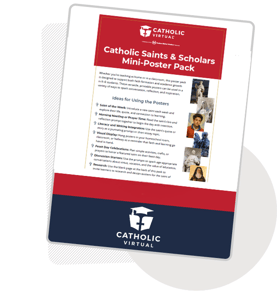

Catholicism has long upheld the dignity of the intellect, encouraging us to seek truth in both divine revelation and human reason. A solid academic foundation strengthens a child’s ability to think critically, discern wisely, and serve creatively in the world–during the early years and throughout life.
When we encourage our children to pursue excellence in math, reading, science, and the arts, we are helping them develop the gifts God has given them. Academic knowledge becomes a tool for:
Faith and reason, heart and mind—these are not rivals, but companions in the formation of the whole child.
The most effective way to balance academics and faith is not to add more. Homeschoolers already have full schedules and oftentimes many commitments to balance. Instead, the goal is to intentionally blend faith and academics within existing timeframes and schedules. Here are a few suggestions:
Simple rituals create strong anchors. Whether you are learning at home or heading out to a class or field trip, begin each day with a morning offering or Scripture reading and close with a prayer of thanksgiving or an examination of conscience.
Catholic identity doesn't need its own "subject block"—it can be (and is!) part of everything:
A great support to Catholic families and homeschoolers is the liturgical calendar, which offers a built-in guide for balancing study and spirituality throughout the year.
Use the seasons of the Church—Advent, Christmas, Lent, Easter, and Ordinary Time—as a framework for planning both spiritual activities and academic pacing.
Advent: Focus on hope and preparation with Jesse Tree devotions, Advent calendars, and art projects.
This liturgical rhythm brings balance by helping families shift focus naturally throughout the year and demonstrates the rich traditions that Catholics share year round.
The communion of saints offers a timeless "faculty" of role models—real people who excelled in both faith and vocation.
Incorporate saint biographies, feast day celebrations, and crafts into your weekly plans. Some ideas include:
Saints make abstract virtues—like courage, humility, or perseverance—more tangible for children, and their stories inspire today’s young people in many ways.
Sacramental preparation and celebration offers key opportunities for deepening both understanding and faith in the homeschool setting.
Whether your child is preparing for First Reconciliation, First Communion, or participating in the Mass, tie your academic plans to these spiritual milestones.
Talk about the sacraments that you have celebrated in your family, and those you prepare to celebrate. Discuss the meaning of the sacraments in your faith and family lives.
With all the possibilities for faith integration, it’s easy to feel pressure to “do it all.” But the most balanced Catholic homeschool isn't the busiest—it’s the one most rooted in love, prayer, and presence.
In Catholic homeschooling, we are choosing both strong academics and strong faith, because we believe education should prepare our children for more than college or career—it should prepare them for heaven. By rooting your homeschool in the rhythm of prayer, the wisdom of the Church, the lives of the saints, and the beauty of the sacraments, you can create a learning environment where children grow in both faith and knowledge.

In today’s connected world, learning a second language is one of the most valuable gifts families can offer children. Beyond academics, it opens...

Families who homeschool often look for ways to challenge their high school students academically while preparing them for college. As colleges and...

Many Catholic parents today are discovering that Education Savings Accounts (ESAs) can help make Catholic education, including online and...